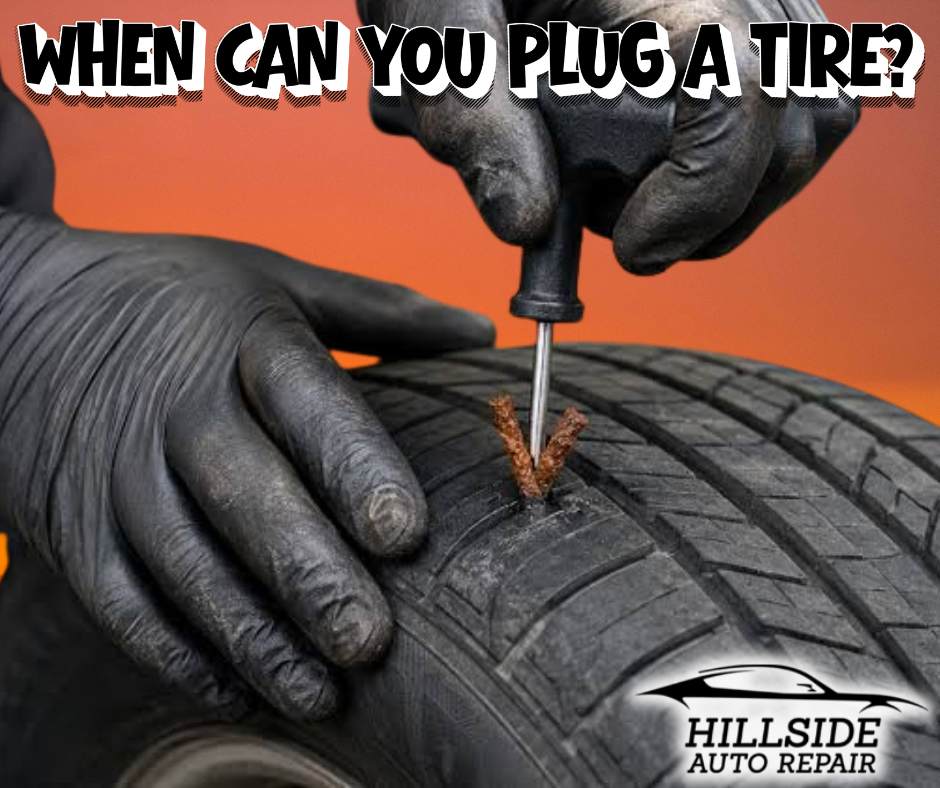
We have all been there. You are cruising down Highway K or navigating the parking lot at the Mid Rivers Mall, and you hear that dreaded thumping sound. A quick visual inspection reveals a nail or screw lodged in your tire. The immediate thought for many drivers is to grab a tire plug kit from the auto parts store and fix it themselves. However, as the team at Hillside Auto Repair, we want to clarify that while a tire plug can be a temporary lifesaver, it is not a one-size-fits-all solution. Understanding the strict limitations of tire repairs is critical to ensuring your safety and the safety of your family on the road.
When can you plug a tire?
The industry standard, backed by the Rubber Manufacturers Association, provides very specific guidelines. A tire can be repaired with a plug (or, more ideally, a combination patch/plug) if the puncture is located in the tread area, which is the thickest part of the tire. Specifically, the puncture must be within the top two inches of the tread area, away from the shoulder or sidewall. The hole itself must be a straight, clean puncture, typically caused by a nail or screw that is less than a quarter of an inch in diameter. If you pick up a nail in the center of the tread, you are likely a candidate for a repair.
When can you NOT plug a tire?
Conversely, there are absolute "no-go" zones when it comes to plugging a tire, and this is where we see the most dangerous DIY attempts. You absolutely cannot plug a tire if the puncture is in the sidewall or the shoulder of the tire. The sidewall flexes constantly as you drive, and it does not contain the steel belts necessary to hold a plug securely. A plug in the sidewall is a guaranteed failure waiting to happen. Furthermore, if the puncture is larger than a quarter of an inch, if the tire has been driven on while flat (which damages the inner liner), or if there is visible cracking, weather rot, or blisters on the tire, we will refuse to repair it. It is also important to note that a tire plug alone, without an internal patch, is no longer considered a safe repair for long-term use.
We often have customers ask why they cannot simply use the sticky rope plug they bought at the store. The reasoning is rooted in physics and safety. A traditional plug fills the hole from the outside, but it does not seal the inner liner of the tire. Air pressure pushes outward against that liner, and a simple plug can allow moisture to seep in, leading to steel belt corrosion over time. This is a ticking time bomb. At Hillside Auto Repair, we exclusively use a combination patch/plug unit that is applied from the inside of the tire. This involves removing the tire from the rim, prepping the area, and pulling a vulcanizing stem through the hole while a large patch seals the inner liner. This restores the structural integrity of the tire and is the only method we consider safe for the roads of O'Fallon.
Maintenance Advice
Maintaining your tires is the best way to prevent finding yourself in a situation where you are asking "can this be fixed?" or, worse, dealing with a catastrophic blowout. O'Fallon weather can be extreme, from scorching summers on Highway 40 to icy winters on the back roads. We recommend checking your tire pressure at least once a month, including the spare. Underinflation generates excess heat, which is the leading cause of blowouts, while overinflation makes the tire brittle and prone to damage from potholes. Furthermore, rotating your tires every 5,000 to 7,000 miles ensures even tread wear, and we always urge our customers to visually inspect their tires for cuts, bulges, or embedded objects regularly. A few seconds of prevention can save you from a terrifying highway blowout and a hefty tow bill.
Why Trust Hillside Auto Repair?
When it comes to repairing a tire or ensuring your vehicle is roadworthy, you need a trusted partner who follows the rules, not just the easiest path. That is where Hillside Auto Repair comes in. We are a comprehensive auto repair shop in O'Fallon, meaning our technicians are equipped to handle a wide range of repairs, from minor fixes like this to major engine overhauls. We pride ourselves on using the exact same tools and equipment that the dealership uses, ensuring that your vehicle receives factory-level diagnostics and repair quality without the inflated dealership prices. Beyond tires, we offer multiple other system maintenance services, including brake fluid flushes, engine diagnostics, and suspension work, ensuring your entire vehicle is in harmony.
Ultimately, your safety is our priority. We carry a robust 3-year/36,000-mile warranty for all services we provide, giving you the peace of mind to drive confidently anywhere in the St. Louis metro area. Trusting a professional with your tire repair isn't just about fixing a flat; it is about verifying that the entire tire is safe for the miles ahead. So, the next time you spot that nail in your tire, resist the urge to grab the rope kit from the gas station. Bring it to us. We will inspect it thoroughly and provide a repair that is built to last, or inform you honestly if it is time for a replacement.