The Tiny Switch That Runs Your Car
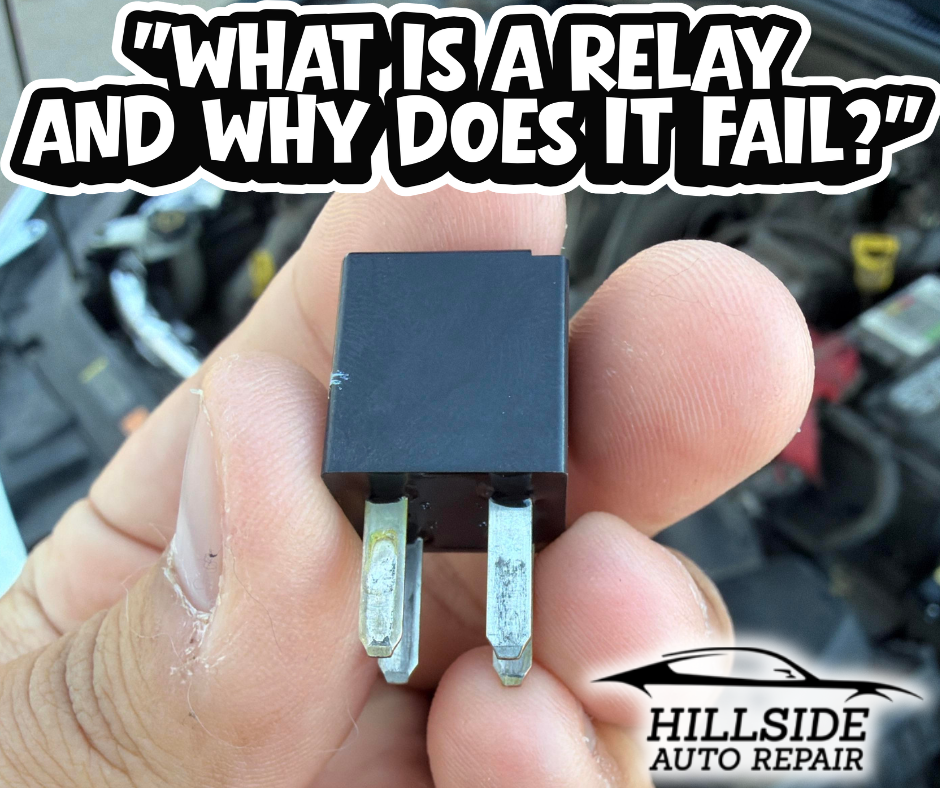
If you have ever flipped a light switch in your home, you understand the basic idea behind a relay. It is a switch, but instead of your finger doing the flipping, electricity does the work. In your vehicle, relays are everywhere. They hide under the hood, behind the dash, and in fuse boxes you may never have noticed. At Hillside Auto Repair, we see relays controlling everything from your fuel pump to your headlights to your cooling fans. They are small, inexpensive, and absolutely critical. When one fails, the symptoms can be baffling. A car that will not start or a fan that will not spin often sends drivers in O'Fallon searching for a major mechanical problem when the real culprit is a tiny switch the size of a matchbox.
How a Relay Actually Works
A relay is an electromagnetic switch that lets a low-current circuit control a high-current load. Inside the relay housing, a small coil of wire creates a magnetic field when electricity flows through it. That magnetic field pulls a metal contact arm closed, completing a second, heavier circuit. Think of it as a strongman waiting behind a door. Your ignition switch does not have to carry the full current for your fuel pump. It just sends a small signal to the relay, and the relay does the heavy lifting. This design protects delicate switches and wiring throughout your vehicle. It also allows manufacturers to route power more efficiently and keep wiring harnesses lighter and simpler.
The Wear and Tear You Never See
Every time a relay opens and closes, the contacts inside arc slightly. That tiny spark is normal, but it is not harmless. Over thousands of cycles, the arcing wears away the contact metal and builds up carbon deposits. The contacts can pit, corrode, or develop a resistive film. Heat from the engine bay accelerates this process, and so does vibration from O'Fallon roads that have seen plenty of freeze and thaw cycles. Eventually, the relay reaches a breaking point. The contacts may stick closed, which means the component runs constantly even when it should be off. Or the contacts may fail to close at all, which means the component simply does not work. Either way, the result is a vehicle that behaves unpredictably.
Symptoms That Mimic Bigger Problems
This is where relays earn their reputation as diagnostic troublemakers. A failed fuel pump relay looks exactly like a failed fuel pump. A stuck cooling fan relay can drain your battery overnight or cause a fan to run until it dies. An intermittent relay can produce symptoms that come and go, frustrating drivers and technicians alike. We have seen vehicles towed into our shop with complaints of no-start conditions, only to find a fifteen dollar relay at the root of it all. That is why we test before we replace. We check coil resistance, contact continuity, and voltage drop under load. Those three tests tell us whether the relay is healthy, marginal, or dead. Guessing is expensive. Testing is smart.
Why Cheap Relays Are a Bad Bet
Not all relays are created equal. OEM relays have specific contact materials and coil characteristics engineered for the load they carry and the environment they live in. Discount relays often cut corners on contact plating and coil quality. They may work fine for a few months, then fail early or weld closed under load. A relay that welds closed can cause a short circuit, and in the worst cases, a fire. For a component this inexpensive, there is no reason to gamble. We install relays that meet or exceed the original specifications. That approach protects your vehicle, your wallet, and your safety. It also means you are not back in the shop a season later chasing the same problem.
Why Hillside Auto Repair Is Your O'Fallon Partner
Diagnosing electrical gremlins takes patience, experience, and the right equipment. Since 1985, Hillside Auto Repair has been the professionals you can trust in O'Fallon. We offer comprehensive auto repair services, and our technicians are equipped to handle a wide range of repairs, from minor fixes to major overhauls. We use the same tools and equipment that the dealership does, so your vehicle gets dealer-level diagnostics without the dealer-level runaround. We also offer multiple other system maintenance services to keep your car reliable year round. Every service we provide is backed by a 3-year/36,000-mile warranty. When we diagnose a relay, you can trust that we tested it properly and that the replacement will last.
Test First, Replace Second
A fifteen dollar relay can cause symptoms that look like a five hundred dollar module failure. That single fact sums up why proper diagnosis matters so much. We do not throw parts at a problem and hope something sticks. We measure, we verify, and we confirm the fix before your keys go back in your hand. If your car is acting up in ways that make no sense, bring it to us. We will find the truth, whether it lives in a module or in a tiny switch under the hood. Because in our experience, the smallest component in the circuit is often the one holding the whole show together.