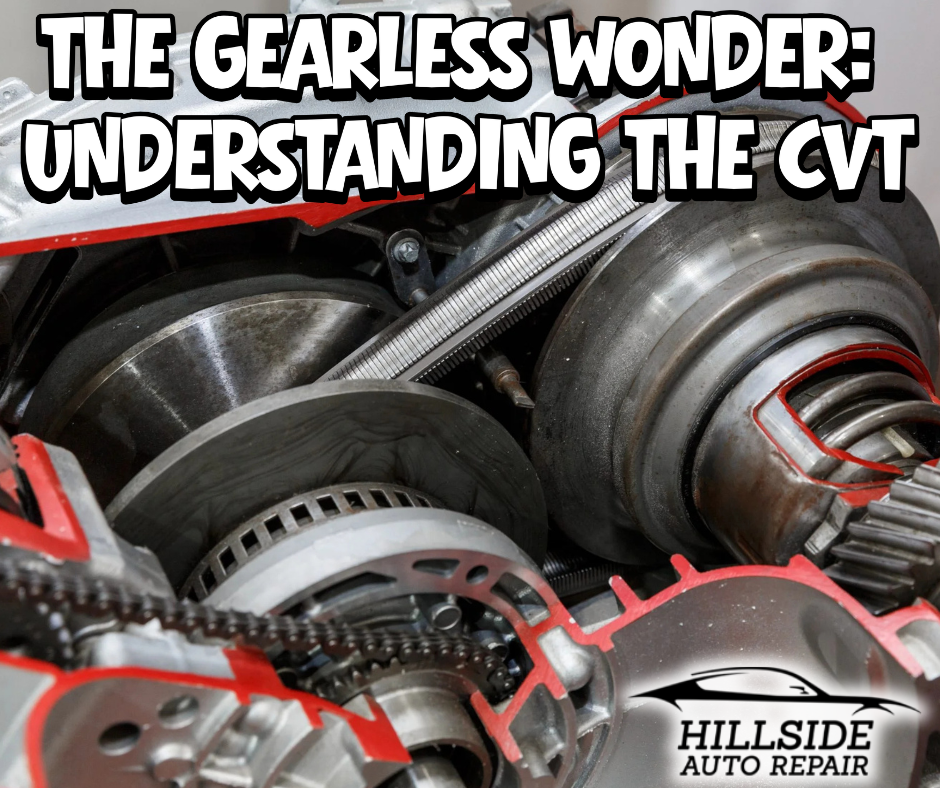
For drivers in O'Fallon, from the highways to the stop-and-go on Highway K, the way your car shifts gears defines your driving experience. While many are familiar with the traditional automatic or the classic manual, a third option has become increasingly common under the hood: the Continuously Variable Transmission, or CVT. Unlike a standard automatic that uses a set of gears to find the right ratio, a CVT uses a system of pulleys and a steel belt to provide an infinite number of gear ratios. This means instead of feeling the distinct "thumps" of a transmission shifting, a CVT provides a seamless, smooth surge of power.
A History Steeped in Genius
It might surprise you to learn that the concept for this seemingly modern transmission dates back to the Renaissance. The first known design for a stepless transmission was sketched by none other than Leonardo da Vinci in 1490. While he never built a working prototype for a car, his concept of a variable drive was far ahead of its time. Centuries later, the idea was used in industrial applications and eventually found its way into the automotive world. The technology has evolved significantly, but the core principle of a seamless, gearless drive is a testament to an idea that was truly revolutionary.
The Clear Advantages of a CVT
So why have so many manufacturers adopted the CVT? The reasons are compelling, especially for everyday drivers. The primary advantage is exceptional fuel economy. Because the CVT can keep the engine running at its most efficient RPM, it maximizes every drop of gas. This is a major plus for anyone looking to save money at the pump. Additionally, the smooth, uninterrupted acceleration provides a refined and quiet ride that many drivers have come to appreciate. For many modern vehicles, from the efficient Honda HR-V to the capable Subaru models that are standard with their Lineartronic CVT, this transmission is the key to balancing performance with fuel efficiency.
The Crucial Maintenance Myths
However, this advanced technology comes with specific needs, and this is where we see many O'Fallon drivers run into trouble. The most pervasive myth we encounter is the idea of "lifetime transmission fluid." We cannot stress enough: this is a fallacy. That "lifetime" claim from the manufacturer simply refers to the expected life of the vehicle's warranty, not the actual lifespan of the car. With internal pressures exceeding 700 PSI, the transmission fluid is the lifeblood of a CVT. We highly recommend a drain and fill of your CVT fluid every 30,000 miles to prevent premature wear. A flush is not recommended as it can dislodge debris and cause more harm. You also want to avoid heavy towing; a vehicle like a Nissan Rogue is not designed for hauling trailers, and doing so can lead to catastrophic overheating and failure.
The Common Problems We See
When a CVT is neglected, the consequences are rarely subtle. We have seen far too many cases in our shop where a simple fluid change could have prevented a bill of thousands of dollars. The most common issues we diagnose are related to valve body failures and worn steel belts. When the fluid breaks down, it loses its ability to properly lubricate and cool the internal components. This leads to erratic shifting, a jerking sensation at low speeds, or a complete loss of power while driving. Another frequent complaint we hear is a whining or droning noise that increases with engine speed. These are not sounds you should ignore; they are your vehicle crying out for professional attention.
Which Models Are Affected
CVT technology is no longer a niche experiment; it is a mainstream standard. Several major manufacturers have embraced it as their go-to transmission for a wide range of models. You will find CVTs as the standard equipment in nearly every new Nissan, including the Altima, Rogue, and Pathfinder. Subaru uses them across almost their entire lineup, from the Crosstrek to the Outback and Forester. Honda has integrated CVTs into the Civic, Accord, and CR-V. Toyota utilizes a version of the technology in the Corolla and the CH-R. Even luxury brands like Audi and Lexus employ variations of the continuously variable transmission in certain models. If you drive one of these vehicles, you are likely relying on this specific engineering every single day.
Why Trust Hillside Auto Repair
Given the complexity and sensitivity of these units, you simply cannot trust a CVT repair or service to just any mechanic. This is precisely why Hillside Auto Repair exists. We do not treat your transmission like a mystery box; we treat it with the precision and respect it deserves. We offer comprehensive auto repair services, and our technicians are equipped to handle a wide range of repairs, from minor fixes to major overhauls. When it comes to the delicate internals of a CVT, we use the exact same tools and equipment that the dealership does, ensuring that your vehicle receives a factory-quality level of care without the dealership markup.
Beyond just transmission work, we provide multiple other system maintenance services to keep your entire vehicle running like new. We carry a 3-year or 36,000-mile warranty for all services we provide, giving you absolute peace of mind. If you are driving a late-model vehicle through the streets of O'Fallon, you need a shop that understands the specific pressures, fluids, and failure points of a CVT. We have that knowledge, and we are ready to put it to work for you. After all, your car is one of your biggest investments; do you really want to leave its most complex component to chance? See you in the shop.