Here in O'Fallon, Missouri, we know a thing or two about the importance of reliable transportation. Whether you are cruising down Highway K or navigating the bustling streets near the Civic Park, having a vehicle you can trust is non-negotiable. At the heart of that trust is your braking system. We often take for granted the simple act of pressing our foot down and watching our vehicle come to a smooth, safe stop. But the technology that makes this possible is the result of over a century of innovation, trial, error, and genius. At Hillside Auto Repair, we believe that understanding this history gives you a deeper appreciation for the complex machine you drive every day.
The Roots of Brakes
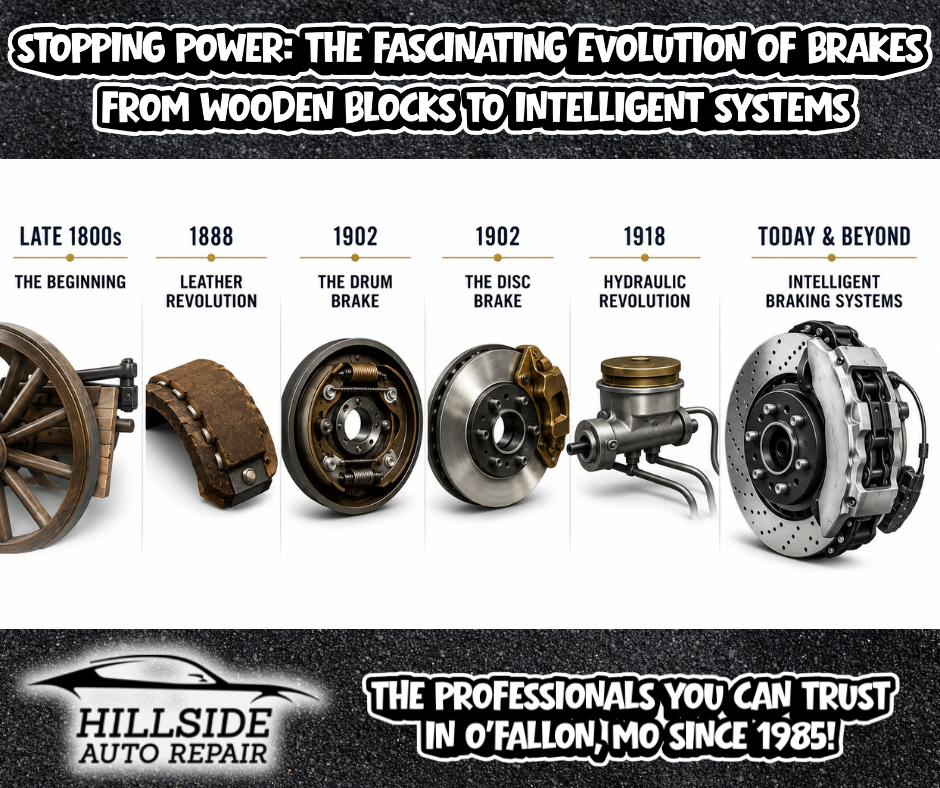
The very first "brakes" on motorized vehicles were incredibly rudimentary, borrowed directly from the horse-drawn carriage era. When the first automobiles hit the roads in the late 1800s, stopping required a hand lever that pressed a simple block of wood against the rear wheels. It was a basic concept that worked at low speeds, but it was far from perfect. The friction of wood on wood or wood on metal generated heat, wore down the blocks quickly, and offered little stopping power in an emergency. The need for something more reliable became apparent almost immediately, and the first major improvement was actually born out of a real-world crisis on the road.
Bertha Benz, wife of Karl Benz, is credited with an innovation that still influences modern brake pads. On her historic 60-mile road trip in 1888, the original wood blocks on her husband's creation wore out. Never one to be deterred, Bertha sought out a blacksmith and had him nail leather pads onto the brake shoes. This act of roadside ingenuity created the first leather brake lining, a revolutionary step that provided more consistent friction and durability. While she was not a mechanic by trade, her practical solution in the face of a breakdown highlights the constant drive for better performance that has always fueled automotive engineering.
Evolving with the Times
The turn of the 20th century brought us the foundational designs we still use today. In 1902, two pivotal inventions emerged almost simultaneously. French industrialist Louis Renault patented and built the first functional mechanical drum brake system. His design used brake shoes lined with friction material that pressed outward against the inside of a rotating drum attached to the wheel. This design was powerful and compact. Across the English Channel, British engineer Frederick W. Lanchester invented and patented the first modern disc brake design. While his disc brake was ahead of its time, it was initially more expensive to produce and did not gain widespread popularity until decades later when higher-speed vehicles demanded better heat dissipation.
The next giant leap came from American engineer Malcolm Lockheed, who developed the first functional four-wheel hydraulic braking system in 1918. Instead of relying on cables and mechanical linkages that could stretch or break, Lockheed's system used fluid pressure to activate the stopping force at all four wheels simultaneously. This was a game changer. Hydraulic brakes provided more balanced stopping power, better pedal feel, and greater reliability. That basic principle, using brake fluid to transfer force from your foot to the brake pads, remains at the core of nearly every passenger vehicle on the road today.
Modern Marvels
Fast forward to the modern era, and brake technology has become nothing short of intelligent. Today we have anti-lock braking systems that pulse the brakes hundreds of times per second to prevent wheel lockup during panic stops. Electronic stability control uses those same brake sensors to help keep you on your intended path. We now have brake assist that detects emergency stopping and applies maximum pressure instantly. Carbon-ceramic rotors offer incredible fade resistance for high-performance driving. Even regenerative braking in hybrid and electric vehicles captures energy during deceleration to recharge the battery. These systems are precise, computer-controlled, and incredibly effective, but they are also complex.
How Hillside Auto Repair Can Help
That complexity is exactly why you need a trusted mechanic shop like Hillside Auto Repair right here in O'Fallon. We offer comprehensive auto repair services, and our technicians are equipped to handle a wide range of repairs, from minor fixes to major overhauls. We use the same tools and equipment that the dealership does, ensuring that your vehicle gets the highest standard of care without the dealership price tag. Beyond brake service, we also offer multiple other system maintenance services, including engine diagnostics, suspension work, and routine fluid exchanges. Every service we provide comes with our 3-year/36,000-mile warranty for your complete peace of mind. After all, understanding the history of brakes reminds us that stopping safely is not a luxury, it is a necessity.
So the next time you press that pedal and your vehicle responds instantly, remember the century of brilliance that made it possible, and remember that Hillside Auto Repair is here to keep that brilliance working flawlessly.