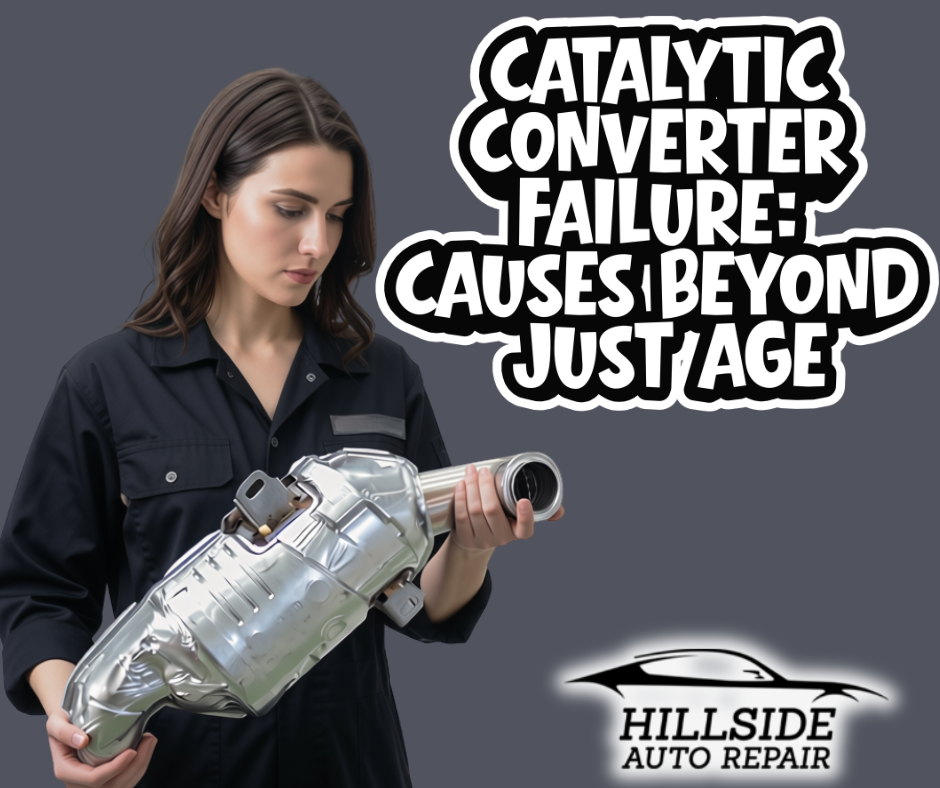
Your Catalytic Converter Has a Tough Job
Your catalytic converter may not be the most glamorous component under your vehicle, but it plays a critical role in keeping your emissions under control. Located within the exhaust system, the catalytic converter helps transform harmful gases produced during combustion into less harmful emissions before they leave your tailpipe. When it is working properly, you probably never think about it. When it starts to fail, however, your vehicle has a way of making its presence known.
Here in O’Fallon, Missouri, we see vehicles dealing with all kinds of exhaust and emissions problems. From daily commuters navigating Highway K and I-70 to family SUVs hauling kids around St. Charles County, vehicles experience plenty of stop-and-go driving, short trips, seasonal temperature changes, and demanding conditions. While age can certainly contribute to catalytic converter failure, it is far from the only reason these components fail.
Age Is Not Always the Culprit
Catalytic converters can last a long time, but they are not designed to survive every problem that happens upstream of them. In fact, one of the biggest mistakes we see is assuming that a failed catalytic converter simply wore out because the vehicle has a lot of miles on it. Sometimes the converter itself is the victim, not the original problem. A catalytic converter can be damaged by excessive heat, contamination, physical impact, or problems with the engine that cause the converter to work far harder than it should. Replacing the converter without identifying what caused the failure can potentially turn an expensive repair into an expensive repeat repair. That is why proper diagnosis matters before anyone reaches for the parts catalog.
When Your Engine Sends Too Much Fuel Downstream
One of the biggest enemies of a catalytic converter is unburned fuel entering the exhaust system. A properly operating engine burns the appropriate air and fuel mixture inside the combustion chamber. When something goes wrong, excess fuel can make its way into the exhaust and eventually reach the catalytic converter. A malfunctioning fuel injector, ignition problem, oxygen sensor issue, or other engine management problem can contribute to an improper air-fuel mixture or incomplete combustion. When that extra fuel reaches the catalytic converter, it can ignite inside the converter and create extreme temperatures. Over time, that excessive heat can damage the catalyst material inside. This is one reason a check engine light should never be treated like an annoying suggestion to "deal with it later." The light may be warning you about a problem that could eventually damage another, considerably more expensive component.
Misfires Can Cook a Converter
Engine misfires deserve special attention because they can be particularly hard on the exhaust system. When a cylinder fails to properly ignite the air-fuel mixture, that unburned mixture can travel into the exhaust. The catalytic converter then has to deal with fuel that should have been burned inside the engine. Repeated misfires can create enough heat to damage the converter's internal substrate. What begins as something relatively straightforward, such as an ignition or fuel system problem, can eventually become a catalytic converter problem too. That is why we do not believe in simply replacing whatever component happens to have triggered a diagnostic trouble code. A code tells us where the vehicle's computer detected a problem. It does not always tell us why that problem happened. Our job is to investigate the system and determine the underlying cause.
Overheating Is Bad News Under the Vehicle
Catalytic converters operate at high temperatures by design. They need heat to perform their chemical reactions, but there is a significant difference between operating temperature and excessive temperature. When an engine runs improperly, the converter can become dangerously hot. Engine overheating can also create additional problems throughout the vehicle. Coolant, oil, and other fluids have specific jobs and specific places where they belong. When a mechanical problem causes contamination or abnormal operating conditions, the catalytic converter may ultimately pay the price. We look at the entire vehicle rather than treating the exhaust system as an isolated collection of parts. That approach helps us determine whether the converter is actually the root of the problem or whether something else has been quietly causing damage.
Physical Damage Can Be a Converter Killer
Not every catalytic converter failure starts inside the engine. Your converter is located underneath the vehicle, which means it is exposed to road hazards, debris, water, temperature extremes, and the occasional unpleasant encounter with a pothole. A significant impact can damage the converter's housing or internal structure. In some cases, the ceramic substrate inside can crack or break apart. When that happens, you may hear rattling from underneath the vehicle, experience reduced performance, or notice other exhaust-related symptoms. If your vehicle suddenly sounds like someone put a box of rocks underneath it, we recommend letting us take a look before you assume it is just another mysterious noise. Your vehicle should not be auditioning for a percussion section.
Contamination Can Quietly Destroy the Catalyst
Catalytic converters can also be damaged by contaminants entering the exhaust system. Certain engine problems can allow oil or coolant to enter the combustion process, and those substances can contaminate the catalyst material. Once contaminated, the converter may no longer be able to perform its job effectively. This is another example of why replacing the converter alone may not solve the problem. If an underlying oil consumption, coolant intrusion, fuel system, or combustion issue remains unresolved, the replacement converter could eventually suffer the same fate. We want to know what happened, not simply what part failed. That distinction can make a major difference when it comes to protecting your vehicle and your repair investment.
What Does a Failing Catalytic Converter Feel Like?
Catalytic converter problems can produce a variety of symptoms, and some can overlap with other vehicle problems. You may notice a check engine light, reduced acceleration, poor fuel economy, unusual exhaust odors, rattling underneath the vehicle, or a noticeable lack of power. A severely restricted converter can prevent exhaust gases from leaving the engine efficiently. Think of it as trying to breathe through a straw that someone keeps squeezing shut. Your engine may struggle to perform because it cannot efficiently get rid of the exhaust gases it has produced. Because several different problems can create similar symptoms, accurate diagnosis is important. Guessing at the problem can get expensive quickly, particularly when catalytic converters are involved.
Why Diagnosis Comes Before Replacement
At Hillside Auto Repair, we believe good automotive repair starts with good information. Our technicians use modern diagnostic equipment and proven testing procedures to determine what is happening with your vehicle before recommending repairs. We use the same tools and equipment that the dealership does, giving us the ability to diagnose today's increasingly sophisticated vehicles without requiring you to take your vehicle to the dealership for every problem. Our comprehensive auto repair services allow us to look beyond a single component. Whether the problem involves the engine, fuel system, ignition system, exhaust system, emissions system, cooling system, or another vehicle system, our technicians are equipped to handle a wide range of repairs, from minor fixes to major overhauls.
Your O’Fallon Auto Repair Professionals Since 1985
Hillside Auto Repair has been serving O’Fallon and the surrounding community since 1985. That means we have seen automotive technology evolve from systems that were comparatively simple to today's highly computerized vehicles packed with sensors, modules, sophisticated emissions controls, and advanced engine management systems. Just because we have been doing this since 1985 does not mean we are stuck in 1985. We have continued to modernize our shop, our equipment, and our diagnostic capabilities so we can properly service today's vehicles. We understand that choosing an auto repair shop is about more than finding someone who can replace a part. You need professionals who can diagnose the problem, explain what is happening, perform the repair correctly, and stand behind the work.
More Than Catalytic Converters
Catalytic converter problems are only one piece of the automotive repair puzzle. We offer comprehensive auto repair services and multiple system maintenance services designed to keep your vehicle operating reliably. Our technicians are equipped to handle everything from routine maintenance and minor repairs to major mechanical overhauls. Whether your vehicle needs brake service, engine diagnostics, exhaust repairs, cooling system service, suspension work, maintenance, or another repair, we have the equipment and expertise to get to the bottom of the problem. Keeping up with maintenance can also help identify developing problems before they become larger and more expensive failures. We would much rather help you address a small problem today than meet its much more expensive cousin six months from now.
Confidence That Goes Beyond the Repair Order
We also understand that trusting an automotive repair shop means trusting someone with a significant investment. Your vehicle is part transportation, part financial commitment, and for many O’Fallon families, an essential part of everyday life. That is why we stand behind the services we provide with a 3-year/36,000-mile warranty. We want our customers to have confidence not only in the repair itself, but also in the professionals performing it. When your check engine light comes on, your vehicle loses power, or something underneath the car starts making a noise that definitely was not there yesterday, you should not have to play automotive detective in your driveway. Bring it to a team equipped to diagnose the problem properly.
Trust the Professionals at Hillside Auto Repair
A catalytic converter does not necessarily fail because it has reached a certain birthday. Sometimes it is the final casualty of an engine misfire, fuel problem, overheating condition, contamination, physical damage, or another underlying issue. Finding that cause is the key to making the repair count. At Hillside Auto Repair, The Professionals You Can Trust in O’Fallon since 1985, we combine decades of automotive experience with modern diagnostic tools and equipment. We use the same tools and equipment that the dealership does, while providing the comprehensive service and personal attention you expect from a trusted local repair shop.
So if your vehicle's check engine light has decided to become a permanent dashboard decoration, your exhaust has developed a suspicious rattle, or your vehicle suddenly feels like it has forgotten how to accelerate, let us investigate before the problem gets bigger.