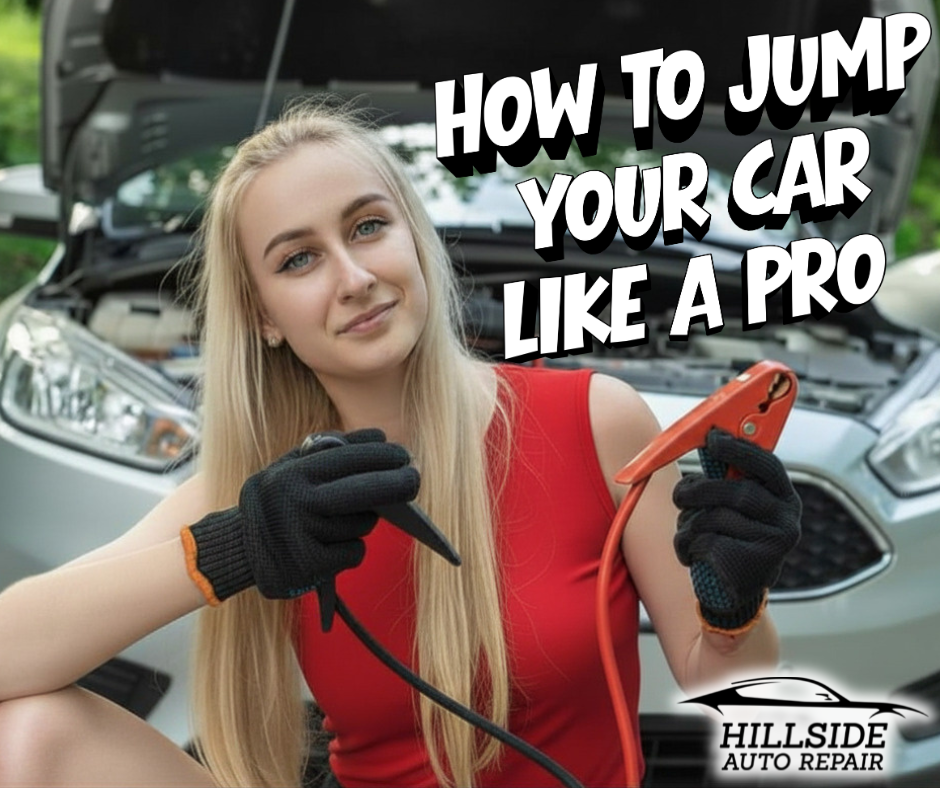
A Guide from Your Friends at Hillside Auto Repair
We have all been there. You are running late for an appointment, or maybe you are just finishing a long day at work in O'Fallon, and you turn the key, only to be greeted by that dreaded clicking sound. A dead car battery is one of the most common automotive inconveniences, but knowing how to handle the situation like a professional can save you time, money, and a lot of frustration. At Hillside Auto Repair, we believe in empowering our customers with knowledge, so we have put together this comprehensive guide on how to jump-start your vehicle safely and effectively.
Symptoms
A battery on its last legs often gives you warning signs before it leaves you stranded. You might notice that your engine is cranking slower than usual when you start your car, or that your headlights are dimmer than they should be. Sometimes, you will hear a rapid clicking sound when you turn the ignition, which is the starter motor trying to engage but not getting enough power. In some cases, your vehicle's electrical components, like the radio or power windows, might start acting erratically. If you experience any of these symptoms, it is a good idea to have your battery and charging system tested by a professional at a reputable O'Fallon shop like ours. However, it is also crucial to know what a jump-start will not fix. Not all batteries can be successfully jumped. If a battery has a damaged cell, is physically swollen or cracked, or is simply old and has reached the end of its service life, a jump-start will not be a permanent solution; it might not even work at all. You should never attempt to jump-start a battery that is visibly leaking fluid or has severe corrosion bridging the terminals. In these cases, the battery needs to be replaced, not revived.
Safety
Before you even pop the hood, safety must be your top priority. Your physical location is a major factor; if you are stranded on the side of a busy O'Fallon road, your first thought should be your personal safety. If possible, try to maneuver your vehicle to a safe, flat spot away from traffic. Turn on your hazard lights to alert other drivers. When positioning the assisting vehicle, ensure it is close enough for the jumper cables to reach comfortably, but make absolutely certain the two vehicles are not touching each other. This is a critical electrical and safety point. When it comes to battery handling, always treat a car battery with respect. It contains sulfuric acid, which is highly corrosive, and produces hydrogen gas, which is explosive. Wear safety glasses and gloves if you have them and never lean directly over the battery while making connections. Also, be wary of battery corrosion. That white, ashy, or blue-tinged substance on your battery terminals is more than just an eyesore; it is a poor conductor that can prevent a jump-start from working and indicates a chemical reaction that can damage your cables. In many cases, cleaning that corrosion off the terminals with a wire brush and a baking soda and water solution is the first step to getting your car started, even before you connect the cables.
Secure
Now, for the proper jump-starting procedure. If you are using a portable jump starter, which we highly recommend keeping in your trunk, follow that manufacturer's specific instructions. These handy little boxes have become incredibly reliable and can save you from having to flag down a stranger for help. They are especially useful if you are in a remote area or if you are a solo driver without another vehicle around. If you are using another vehicle, first turn off the ignitions and all electrical accessories in both cars. Take your jumper cables, which should be in good condition with no frayed wires or damaged clamps. This is the order you must follow: First, connect the red, positive clamp to the positive terminal on the dead battery. Second, connect the other red, positive clamp to the positive terminal on the good battery. Third, connect the black, negative clamp to the negative terminal on the good battery. Finally, and this is a very important step, connect the other black, negative clamp to a clean, unpainted metal part of the car with the dead battery, like a bolt on the engine block or a designated grounding point. Do not connect this final clamp to the negative terminal of the dead battery itself, as the spark that occurs when you complete the circuit could ignite the hydrogen gas and cause an explosion.
Start
Once all connections are secure, start the engine of the vehicle with the good battery and let it idle for a few minutes. This allows its alternator to send a small charge into the dead battery. After a few minutes, attempt to start the vehicle with the dead battery. If it does not start, you can wait a little longer or ask the other driver to rev their engine slightly to increase the charge output. When the dead car finally starts, do not celebrate by immediately jumping out and disconnecting the cables. You need to leave both vehicles connected and running for a few more minutes to stabilize the electrical systems. Once you are ready, remove the cables in the exact reverse order that you put them on: disconnect the black, negative clamp from the formerly dead car first, then the black clamp from the good car, then the red positive clamp from the good car, and finally the red positive clamp from the other car. Be very careful not to let any of the clamps touch each other or the vehicles during this process.
Now that your vehicle is running, your job is not done. You should leave your vehicle running for a good, long while. The battery was drained of its energy to start the car, and now the alternator needs time to replenish it. A short trip around the block is not going to cut it. We recommend that you drive your car for at least 30 minutes to give the alternator enough time to recharge the battery to a decent level. If you can, take it for a longer, uninterrupted drive on the highway. This continuous operation allows the alternator to work most efficiently and ensures that the battery has enough charge to start the car the next time you turn the key. This is why we always tell our customers to not just start the car and let it idle in the driveway; the alternator does not produce its maximum charge at idle speeds. A healthy drive is the best medicine for a recently revived battery.
When you need a Professional
If you find yourself needing a jump-start frequently, or if your battery is more than three to five years old, it is probably time to consider a replacement. Even if a jump-start gets you going, a weak battery will only continue to be a source of trouble, especially during a cold O'Fallon winter. This is where we, at Hillside Auto Repair, come in. We offer comprehensive auto repair services and our technicians are equipped to handle a wide range of repairs, from minor fixes to major overhauls. We use the same tools and equipment that the dealership does, so you can trust us with your vehicle. Beyond battery testing and replacement, we also offer multiple other system maintenance services. For your peace of mind, we carry a 3-year/36,000-mile warranty for all services we provide.
So, you have successfully jumped your car and driven it for thirty minutes. Now what? The smartest thing you can do is swing by Hillside Auto Repair at 400 Church St in O'Fallon, MO. We can test your battery and charging system to determine its overall health and ensure that the alternator is doing its job properly. This simple diagnostic step can save you from being stranded in the future. After all, a jump-start is just a band-aid; we specialize in the actual cure. Is your vehicle showing any of the subtle warning signs we discussed earlier, or are you just due for a routine check-up? We are here to help, because nobody wants to be the person blocking traffic with their hood up in the middle of a Missouri summer.