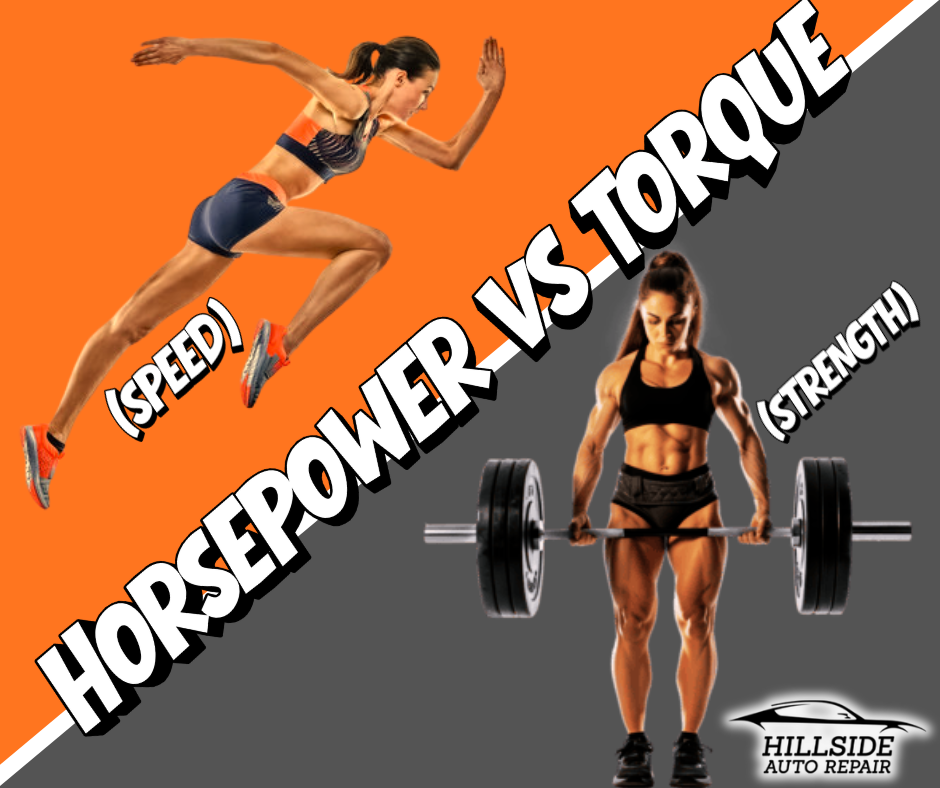
Horsepower vs. Torque: What Your Engine's Numbers Really Mean
If you have ever found yourself in a heated debate at a car meet or simply while browsing the spec sheet of a new vehicle, you have likely encountered the age-old question: horsepower or torque, which is more important? At Hillside Auto Repair, we hear this question frequently from our neighbors here in O'Fallon, Missouri. It is a topic that can seem shrouded in mystery, but understanding the difference between these two measurements is key to understanding how your vehicle behaves on the road. We are here to clear up the confusion and explain exactly what these numbers mean for your daily drive.
TORQUE
Let us start with the fundamental definition of torque. In the simplest terms, torque is a twisting force. It is the force that causes rotation, and in the context of your car, it is the force that gets your vehicle moving from a standstill. Think of it like this: when you use a wrench to loosen a stubborn bolt, the force you apply to the handle is torque. The more torque you have, the more turning power you can exert. In your engine, torque is generated by the combustion process pushing the pistons, which turns the crankshaft. This is the raw, physical effort your engine produces, measured in pound-feet (lb-ft) in the United States. We often tell our customers to think of torque as the "grunt" work.
HORSEPOWER
Now, what about horsepower? While torque is a measurement of force, horsepower is a measurement of power, or more precisely, the rate at which work is done. It is a calculated figure, not a directly measured one. The classic formula connects torque to engine speed, which is why you will often see horsepower peak at a higher RPM than torque. Horsepower represents how quickly that twisting force can be applied over time. If torque is the grunt, horsepower is the endurance and top-end speed. It is the reason your engine can keep pulling hard as you accelerate down Highway K or merge onto Interstate 70. Without horsepower, your torque would be impressive but ultimately useless for high-speed driving.
The similarity between the two is that they are intrinsically linked; you cannot have one without the other. They are two sides of the same combustion coin. A high-horsepower engine is essentially an engine that produces high torque at high RPM, while a high-torque engine produces that force lower in the rev range. The difference lies in where and how that power is delivered. Torque is what you feel when you stomp on the accelerator from a red light on Bryan Road. It is that initial shove that pins you back in your seat. Horsepower is what keeps you moving at 70 miles per hour on the highway, allowing you to pass slower traffic without downshifting constantly.
WHICH SITUATION WOULD YOU WANT EACH ONE?
The answer depends entirely on what you do with your vehicle. For the daily driver navigating the hills and stop-and-go traffic of O'Fallon, torque is your best friend. It makes driving feel effortless, reduces the need for constant gear hunting in automatic transmissions, and provides that satisfying surge of power when pulling away from a stop. This is why diesel trucks and larger SUVs are so popular here; they offer mountains of low-end torque for towing boats to the Lake of the Ozarks or hauling gear for weekend projects. On the other hand, if you are a performance enthusiast who enjoys carving through the back roads or hitting the track, horsepower becomes the star of the show. It is what allows your engine to continue making power at high speeds, giving you that thrilling top-end rush and the ability to sustain high velocity.
Now that you understand what is happening under the hood, consider this: all that force and speed creates immense wear and tear on your vehicle. Your engine, transmission, and drivetrain work in perfect harmony to translate torque and horsepower into forward motion, but they need proper care to keep performing at their peak. That is where we come in. At Hillside Auto Repair, we offer comprehensive auto repair services designed to keep every component of your powertrain in top shape. Our technicians are equipped to handle a wide range of repairs, from minor fixes to major overhauls, ensuring your engine continues to produce the power you expect.
We understand that O'Fallon drivers rely on their vehicles for everything from daily commutes to family road trips, and we treat every car that rolls into our shop with the respect it deserves. We use the same tools and equipment that the dealership does, so you can trust that your vehicle is getting dealer-level service without the dealership price tag. Beyond engine work, we also offer multiple other system maintenance services, including transmission fluid flushes, cooling system repairs, and brake services, all of which play a crucial role in maintaining your vehicle's performance. And because we stand behind our work, we carry a 3-year/36,000-mile warranty for all services we provide. That is our promise to you, our O'Fallon neighbors, that we are here to keep your vehicle running strong for the long haul.
So, the next time you are comparing vehicles or debating with friends about which spec matters more, remember that horsepower sells cars, but torque wins races. More importantly, remember that neither one matters if your engine is not properly maintained. Whether you need a simple oil change or a complex engine repair, we have the expertise and equipment to get the job done right. After all, all that horsepower and torque is useless if it is stuck in the shop, right?