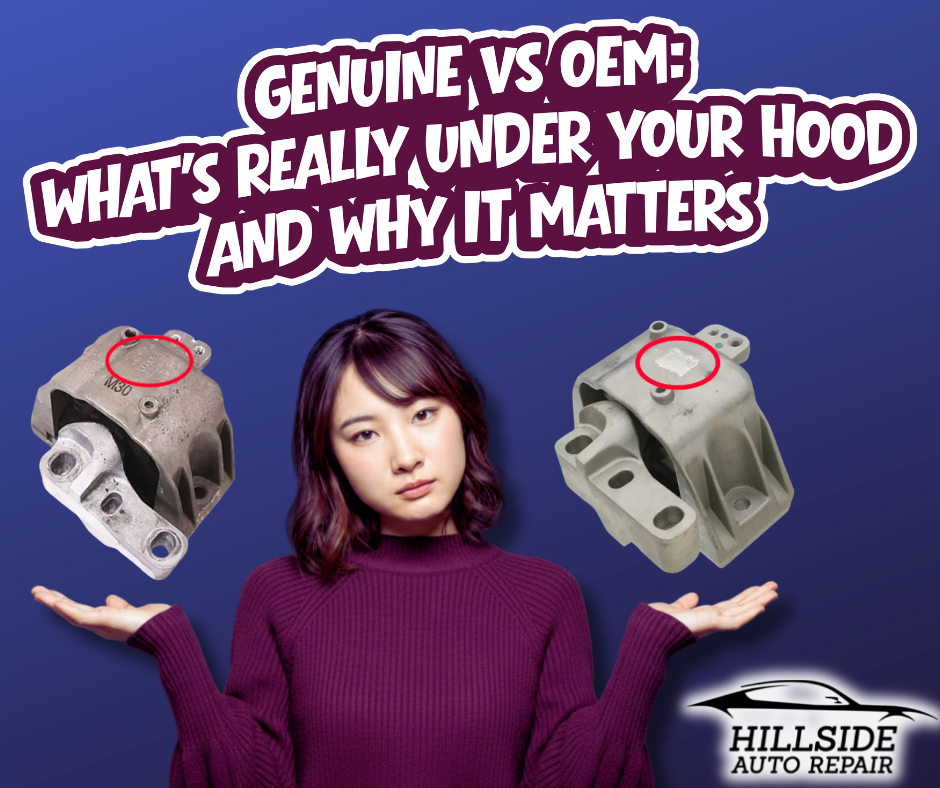
We have this conversation at least three times a week here in O'Fallon. A customer comes in with a repair estimate, looks at the parts pricing, and asks the question that always leads to a longer discussion. What is the difference between a genuine part and an OEM part? Is there really a difference, or are we just splitting hairs to justify a higher price tag? These are fair questions, and as a shop that has been serving this community for years, we believe you deserve a straight answer. So let us break it down in plain English, because understanding this distinction could save you a significant amount of money without sacrificing the quality your car deserves.
Let us start with the definitions, because the terminology gets thrown around loosely and that is where the confusion begins.
What does Genuine mean?
A genuine part comes in a manufacturer-branded box. Think Toyota, Honda, BMW, Ford, or Chevrolet stamped right on the packaging. This is the exact same part that came on your car when it rolled off the assembly line. It has been engineered, tested, and approved by the vehicle manufacturer to meet their specific standards. When you buy a genuine part, you are getting the real deal, the component the factory intended to be under your hood. There is no guesswork involved. It will fit. It will function. It will perform exactly as designed.
Now, what about OEM?
OEM stands for Original Equipment Manufacturer, and this is where things get interesting. An OEM part is made by the very same company that supplies the manufacturer, but it is sold under that supplier's own brand name rather than the car company's logo. For example, Denso makes a massive percentage of the sensors and electrical components for Toyota. Bosch is a major supplier for European vehicles. Lemförder produces suspension components for BMW and Mercedes. When you buy a Denso sensor in a Denso box, you are getting the same part that would come in a Toyota box, just without the Toyota logo and without the Toyota markup.
Here is the reality we see every day on our lifts. The genuine Toyota camshaft sensor might retail for $250. The Denso equivalent, made in the exact same factory to the exact same specifications, might be $120. Same sensor. Same internal components. Same durability. Different box. Different price. That is the OEM sweet spot, and it is why we recommend OEM parts whenever possible. You get dealer-level quality without the dealer-level price tag. It is one of the smartest ways we know to save our customers money without cutting corners on quality.
But we would be doing you a disservice if we did not acknowledge that there are situations where genuine is the better call. Sometimes an OEM equivalent simply is not available for a particular part. Other times, we have seen aftermarket versions of a specific component develop known issues over time, and in those cases, we will steer you toward the genuine part even if it costs more. Our goal is not to sell you the most expensive option. Our goal is to sell you the right option, the one that will keep your car reliable and keep you from coming back with the same problem in six months. A comeback is bad for you and bad for us. We avoid comebacks by making smart parts choices from the start.
Then there is the third category, the one we approach with extreme caution.
Generic aftermarket parts.
These are parts made by third-party manufacturers that have no relationship with the original supplier. Some are perfectly fine. Some are absolute garbage. The problem is that it is nearly impossible to tell which is which without extensive testing and experience. We have seen aftermarket sensors fail within weeks. We have seen suspension components that did not quite fit right and caused premature tire wear. We have seen brake pads that squealed from day one. Buying generic aftermarket is a gamble, and we do not like gambling with our customers' safety or their wallets. We will always advise you based on the specific part and your budget, but we will never recommend a part we would not put on our own vehicles.
Why having a trusted mechanic shop matters.
At Hillside Auto Repair, we do not just throw parts at a problem and hope for the best. We take the time to research the best option for your specific car, your driving habits, and your budget. Our technicians are equipped to handle everything from minor fixes to major overhauls, and we use the same diagnostic tools and equipment that the dealership uses. We offer comprehensive auto repair services across all systems, and every service we provide comes with a 3-year/36,000-mile warranty. When we recommend a genuine part or an OEM part, it is because we have done our homework and we stand behind the choice. You should trust our recommendation because we are not trying to upsell you. We are trying to do the job right the first time and keep you on the road safely.
So the next time you are facing a repair, remember this simple breakdown. Genuine is always safe but expensive. OEM is usually the sweet spot, same quality at a lower price. Generic aftermarket is a gamble, and we will tell you straight up when we think it is worth taking and when it is not.
At Hillside Auto Repair, we treat your car like it is our own because we take pride in being O'Fallon's trusted dealership alternative. We explain the repair before we sell the repair, and we stand by our work.