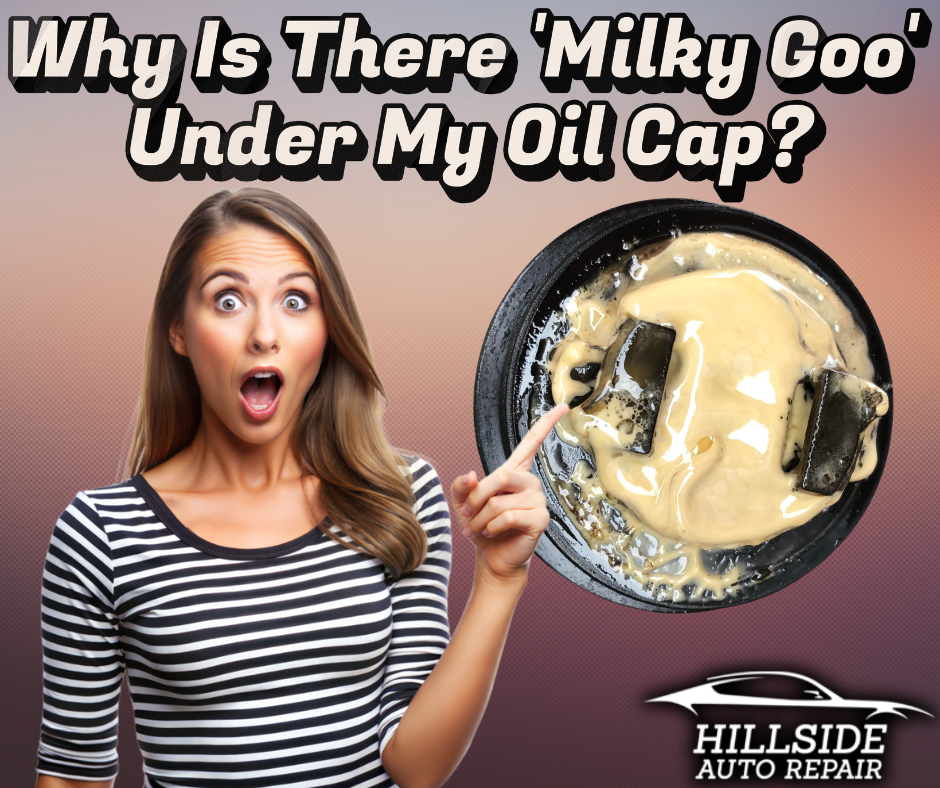
Why Is There "Milky Goo" Under My Oil Cap – Is My Head Gasket Blown?
We have all been there. It is a normal morning, you pop the hood to check your oil or top off the washer fluid, and your heart sinks. You twist the oil cap off and find a disgusting, frothy substance that looks like a melted vanilla milkshake or yellow mayonnaise coating the underside of the cap. Your stomach drops as the internet's scariest diagnosis flashes before your eyes: a blown head gasket. Before you start mentally calculating the cost of a new engine, take a deep breath. At Hillside Auto Repair, we want you to know that this discovery is not always a mechanical death sentence. In fact, during the colder months here in Missouri, we see this "milky goo" so often that it rarely raises our blood pressure anymore. Let us explain the chemistry behind this ugly mess and when it is time to actually panic.
The Science of the Sludge: Condensation, Not Catastrophe
To understand the goo, you have to understand the enemy of every mechanical system: moisture. Your engine is a sealed environment in theory, but in practice, it breathes. It has a positive crankcase ventilation system designed to vent harmful blow-by gases. When your engine runs hot, the normal byproducts of combustion, including water vapor, are burned off and expelled. The magic word here is "hot."
The problem arises when an engine never gets a chance to fully warm up. We are talking about the quintessential O'Fallon lifestyle of short, 5-minute trips to Schnucks on Highway K, dropping the kids off at school, or commuting just down Tom Ginnever Avenue to the office. During these short jaunts, the engine block and the oil inside it heat up just enough to create water vapor from the ambient moisture in the air, but not enough to make it boil off and evaporate. When you park the car and the engine cools down, this water vapor condenses back into a liquid. This liquid water gets whipped into the oil vapor splashing around the valve covers, creating an emulsion. That emulsion is the yellow "milkshake" you see clinging to the coldest high point of the engine, which is usually the oil filler cap.
The Definitive "Is It The Head Gasket?" Checklist
At Hillside Auto Repair, we teach our customers a simple home inspection process that often brings instant peace of mind. You need to check three places before you lose sleep. First, check the underside of the oil filler cap. If you see the yellow goo there, that is the first data point, but it is not the conclusion. Second, pull the actual dipstick. This is the truth teller. If the oil on the dipstick looks like normal oil, either clean or dark and used but still transparent, you are almost certainly dealing with simple condensation. It takes a massive failure to turn four to six quarts of hot oil into a milkshake. If the dipstick is clean, the oil in the actual pan is clean. Third, pop the radiator cap, but only when the engine is stone cold. If the coolant is bright green, orange, or pink and the level is stable, your head gasket is likely doing its job perfectly, keeping the coolant passages sealed away from the oil galleries. If you have goo on the cap, clean oil on the dipstick, and normal coolant in the radiator, you do not have a blown head gasket. You have a case of "Short Trip Syndrome."
When The Goo Means The Gloom
Now, we need to be serious for a moment. While 90% of the cap sludge we see in our shop during a Missouri winter is harmless condensation, there is a point where the diagnosis flips. You must be concerned if you pull the dipstick and it looks like a chocolate peanut butter cup, completely coated in thick, frothy goo. If you see white smoke billowing from the exhaust that smells distinctly sweet, like burning syrup, that is coolant entering the combustion chamber. If your coolant reservoir is mysteriously draining with no visible puddle on your driveway, the coolant is being consumed internally. These symptoms, combined with overheating and a rough idle, point to the head gasket failure you originally feared. This is not a repair to gamble with. A failed gasket mixes coolant and oil, and contaminated oil destroys bearings and journals, essentially grinding your engine to glittering death from the inside.
Why You Need a Trusted Mechanic Shop Like Hillside Auto Repair
If that dipstick is clean but you are still feeling a knot in your stomach, we invite you to stop by Hillside Auto Repair and let us take a look. We know trust is earned, not given, which is why we stand behind everything we do with a solid 3-year/36,000-mile warranty. We are not here to sell you a head gasket job you do not need. Our technicians are trained to diagnose with precision, not guesswork. We treat your vehicle with the same care we would treat our own family’s cars, using the same professional-grade tools and equipment you would find at the dealership, without the dealership pricing or the high-pressure upsells.
We are deeply integrated into the O'Fallon community. We understand the driving patterns of our neighbors because we drive the same roads. We know the wear and tear caused by stop-and-go traffic on Highway K, and we tailor our maintenance recommendations based on real-world conditions, not just generic factory intervals. Whether it is a simple oil change, a comprehensive engine diagnostic, or the major overhaul you hope you never need, our technicians are equipped to handle a wide range of repairs, from minor fixes to major overhauls. We also offer multiple other system maintenance services to keep your entire vehicle in prime condition. We want to be your partner in keeping your car on the road, not just a vendor you dread visiting.
Panicking over a milky oil cap is like diagnosing a hangnail as terminal, and we much prefer being your surgeons of sanity than your harbingers of doom. If your engine is acting up or you just want the confidence of a professional second opinion, come see us.