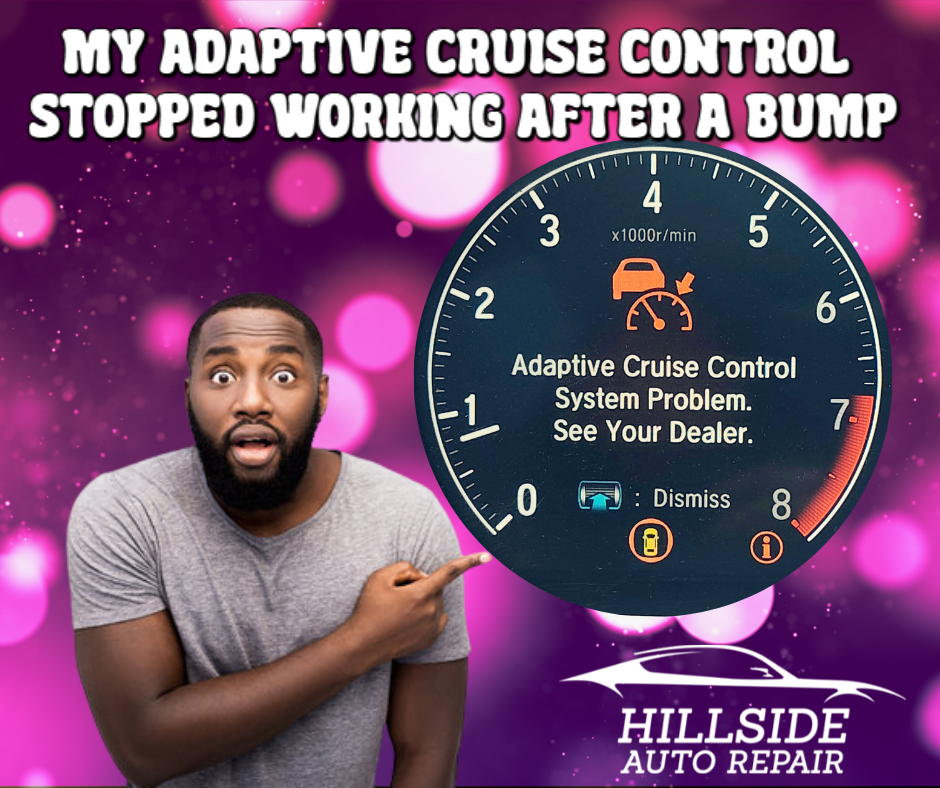
You’re cruising down Highway K or navigating the roundabouts near Fort Zumwalt West, and you hit it, a pothole left over from winter or a sharp dip entering a shopping plaza. It wasn’t even that hard of a bump. You barely spilled your coffee. But suddenly, a warning light glares at you from the dashboard: "Cruise Control Unavailable," "Front Radar Blocked," or "Collision Mitigation System Malfunction."
Your first thought is usually frustration. Great, another expensive sensor is broken. Your second thought is confusion. It was just a little bump; how bad could it be?
The Delicate Dance of Your Bumper Cover
To understand the issue, you should look to the nose of your modern vehicle. That sleek, painted bumper cover isn't just for show. Behind that plastic, usually mounted on a bracket, is a radar unit. This unit is the "eye" of your adaptive cruise control, constantly emitting signals to maintain a safe distance from the car ahead.
When you hit a bump, a few things can happen to that bumper cover:
- The Brackets Break: The plastic tabs or brackets holding the bumper cover to the chassis can snap. This allows the entire bumper cover, and the radar mounted to it, to sag or tilt backward by just a few millimeters.
- The Retainers Pop: Many bumpers are held on by push clips. A hard jolt can pop these out, shifting the bumper’s position.
- The Sensor Bracket Flexes: The metal bracket holding the radar unit itself might have bent imperceptibly.
Even if the bumper looks fine to the naked eye, the radar angle could be off by as little as half a degree. That’s all it takes to send the signal bouncing toward the asphalt or up into the sky, rather than straight ahead at the traffic on Mexico Road.
Why Your Car Shuts Down the System
You might wonder, "Why can't it just work if it's only a little off?" The answer is safety.
These systems are calibrated to specific "aiming" specifications. If the radar is pointed too high, it won't see the car in front of you; it will see the overpass. If it's pointed too low, it will see the road surface as an obstacle, potentially slamming on the brakes for no reason or failing to detect a vehicle ahead.
Manufacturers program the system to perform self-diagnostic checks. When the internal sensors detect that the radar's angle is outside the acceptable tolerance, often because of that bump you hit, it assumes the worst: the sensor is broken, detached, or misaligned. To prevent phantom braking or a failure to brake, it simply disables the system entirely. It’s a "fail-safe" protocol. It’s annoying, but it’s designed to keep you from crashing.
The Calibration Conundrum: Why You Need Hillside Auto Repair
This is where the average DIYer or a trip to a general shop without the right tools hits a wall. Fixing this isn't just about pushing the bumper back into place. Once the bumper or radar bracket is repaired or replaced, the radar must be re-calibrated.
This process requires specialized diagnostic scanners and specific targets (like reflective boards or specific panels placed at exact distances and heights in front of the car). The dealership has these tools, but so do we at Hillside Auto Repair.
We are adept at ADAS systems. We understand that your 2020 SUV or 2023 pickup isn't just a mechanical machine; it's a rolling computer. Our technicians are equipped to handle this wide range of repairs, from minor bumper cover fixes to major suspension overhauls that also affect sensor aiming. We use the same tools and equipment that the dealership does to ensure that after we fix what came loose, your radar sees the road exactly as the engineers intended.
When you bring your vehicle to our shop, we don't just scan the code and reset it. We perform a comprehensive inspection to find out why it failed. Did the bracket break? Is the bumper cover damaged? Was the alignment knocked out? We find the loose component, secure it, and then perform the necessary calibration to get you safely back on the road.
And because we stand behind our work, we carry a 3-year/36,000-mile warranty for all services we provide. Whether it’s a major overhaul or a complex ADAS calibration, you have peace of mind every time you merge onto I-70.
So, the next time you give a Missouri pothole a high-five and your car throws a technological tantrum, don't despair. It’s likely just your car’s way of telling you its "eyes" need a check-up.
After all, your car’s radar is a lot like a good mechanic, it needs to be perfectly level to give you the straight story.